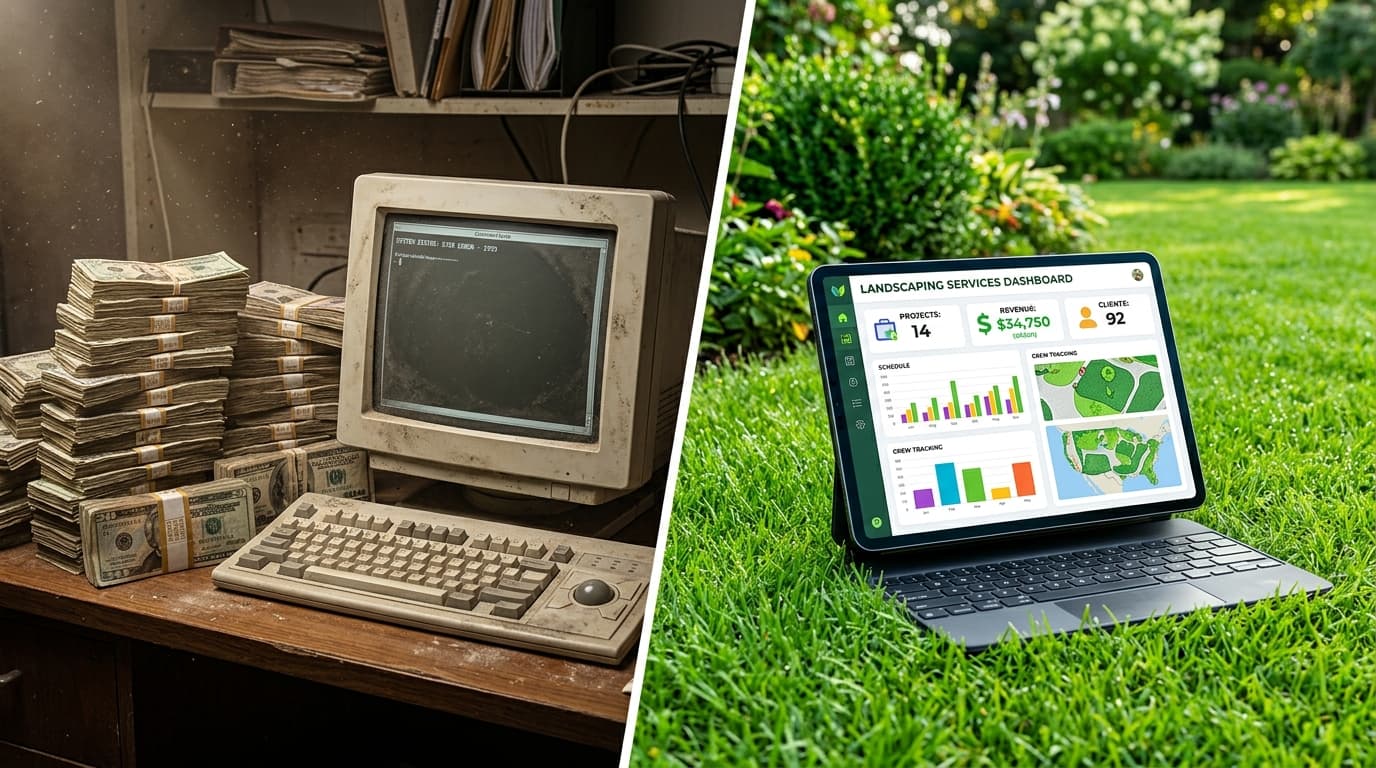
Free Landscaping Software vs. Paid: Which is Right for You?
If you asked a landscaper in 2015 if they ran their business on free software, they would probably laugh at you. Back then, "free" meant downloading a shady Excel template filled with macro viruses or using a basic Google Calendar that had absolutely no concept of route optimization.
But in 2026, the conversation has completely changed.
The software industry has experienced a massive shift toward the "freemium" platform model. Today, some of the most powerful, enterprise-grade tools on the market are completely free to use.
This begs a massive question for landscaping business owners: Are you overpaying for your current software?
In this guide, we are going to break down the true difference between free landscaping software and paid platforms, explore how free software actually makes money, and help you decide which path is right for the current size of your business.
The Legacy Paid Software Model
To understand the current landscape, you have to look at how traditional paid software (like Jobber, Service Autopilot, or Aspire) operates.
These platforms operate on a SaaS (Software as a Service) model. You pay a monthly subscription fee, usually tiered based on the number of users (crew members) you have or the specific features you want to unlock.
Why Are They So Expensive?
Legacy paid software platforms are expensive because of how they were capitalized. Many of them took on tens of millions of dollars in venture capital funding. To satisfy their investors, they have to constantly increase their MRR (Monthly Recurring Revenue).
They do this in two ways:
- Raising Prices: If you have been in the industry long enough, you've likely seen your software bill creep up 10-15% every single year.
- Gating Features: They lock the most useful features (like route optimization, two-way texting, or QuickBooks integration) behind the highest pricing tiers, forcing you to upgrade.
Who Needs Paid Software?
Despite the cost, paid software still has a place in the market. If you are running a $10M+ commercial landscaping firm with 50+ trucks, a dedicated HR department, and complex chemical tracking requirements for municipal contracts, you absolutely need an enterprise paid tool like Aspire. The $1,000+ monthly price tag is a drop in the bucket compared to the value it provides at that scale.
But what if you are doing $250k to $2M in revenue?
The Rise of Free Landscaping Software
For the vast majority of independent operators and mid-sized landscaping companies, the enterprise features of paid software are overkill. You don't need a 40-page reporting matrix; you just need to know where your crews are going today and whether the client has paid their bill.
This gap in the market gave rise to modern, free platforms like YardStak.
How is it Actually Free?
The first question every skeptical business owner asks is: "If the software is free, how are they making money?"
It is a completely valid question. The answer lies in the Platform Model.
Modern free landscaping software doesn't make money by charging you a subscription fee. Instead, they make money by facilitating the transactions that naturally happen within your business.
When you use a platform like YardStak to schedule your routes and manage your CRM, it costs you nothing. But when your crew finishes a job and you use YardStak to process the client's credit card, YardStak takes a standard payment processing fee (usually around 2.9% + 30¢, which is the exact same fee Stripe or Square charges).
The software company is banking on the fact that their free tool will help you grow your business. As you do more jobs and process more payments, they make a fraction of a percent on the volume.
Their incentives are perfectly aligned with yours. They only make money when you actually generate revenue.
Optional Growth Add-Ons
The second way free platforms make money is through optional, highly-specialized add-ons. For example, YardStak gives you the core scheduling and routing software for free. But if you want YardStak's AI engine to automatically build, host, and optimize a local SEO website for your landscaping business, you might pay a small monthly premium for that specific marketing tool.
You are never forced to buy it. You only pay for the tools that actively grow your top-line revenue, rather than paying a flat tax just to access your own schedule.
Comparing the Features: Free vs. Paid
Let's look at a side-by-side comparison of the core features you actually use on a daily basis.
1. The CRM (Client Database)
- Paid Software: Excellent CRM capabilities. You can add infinite custom fields, track every email ever sent, and run complex segmentation reports.
- Free Software (YardStak): A highly streamlined CRM. It tracks names, addresses, phone numbers, property notes, and billing history perfectly. It might lack the ability to create 50 custom data fields, but 99% of users never use those anyway.
- Winner: Tie (Depends on your complexity needs).
2. Route Optimization
- Paid Software: Usually locked behind a $150-$250/month paywall. Works well once configured, but can be clunky to adjust on the fly.
- Free Software (YardStak): Natively included for free. Uses modern Google Maps APIs to instantly calculate the mathematically fastest driving path for the day.
- Winner: Free Software (Value per dollar is unbeatable).
3. The Mobile Crew App
- Paid Software: Often suffers from technical debt. The apps can be slow to load, require a strong cell signal, and are cluttered with features the crew doesn't need to see.
- Free Software (YardStak): Built mobile-first. Incredibly fast, intuitive, and features massive "Start" and "Complete" buttons. Designed specifically for laborers wearing gloves in the sun.
- Winner: Free Software.
4. Advanced Estimating & Job Costing
- Paid Software: Unparalleled. You can build complex estimating matrices based on square footage, plant costs, and exact labor rates down to the minute.
- Free Software (YardStak): Focuses on speed. Great for standard recurring services (mowing, fertilizing, snow removal) and flat-rate quoting. Lacks the deep job-costing matrices required for massive $100k hardscaping installs.
- Winner: Paid Software.
The True Cost of Paid Software
When deciding whether to stick with your paid software or move to a free alternative, you have to look at the opportunity cost.
Let's say you are paying $200 a month for your current software. That is $2,400 a year.
What could you do with an extra $2,400 in cash flow?
- You could run $400 a month in targeted Facebook Ads during the spring rush.
- You could give your best crew leader a $1/hour raise to improve retention.
- You could upgrade your trimmers and blowers to the latest commercial gear.
Every dollar you spend on a software subscription is a dollar you cannot deploy toward actual growth or employee retention. If you are paying for features you aren't actively using, you are actively slowing down your business.
Conclusion: Which is Right for You?
The decision ultimately comes down to the current size and focus of your business.
You Should Choose Paid Software If:
- You run a massive commercial operation (50+ trucks).
- You specialize in complex, multi-week hardscaping or design-build projects that require intense job costing.
- You need to integrate deeply with legacy ERP systems or complex HR software.
You Should Choose Free Software If:
- You are an owner-operator or run a small-to-mid-sized fleet (1-10 trucks).
- The vast majority of your revenue comes from recurring, route-based services (mowing, maintenance, fertilizing, snow removal).
- You are tired of paying hundreds of dollars a month just to see your schedule on a map.
If you fall into that second category, it is time to stop paying the software tax.
Create your 100% free YardStak account today. You can import your entire client list via CSV, set up your recurring routes, and dispatch your crews before the end of the day—all without ever pulling out a credit card.
Ready to dive deeper? Check out our guide on The Best Lawn Care Software App in 2026 or learn How to Automate Your Lawn Care Scheduling & Billing.